
Founder and editor of We Are MacWise, with more than 30 years of Apple-focused IT experience helping professionals and small businesses.
Garmin’s multi-band GPS can hold a positional error below one percent in open terrain, while Apple Watch Ultra 2 closes that gap significantly but still trails in ultra-long battery endurance. If you train seriously — tracking marathon splits, multi-day ultras, or triathlon transitions — those differences are not abstractions. This article works through the actual performance data on Apple Watch vs Garmin for serious athletes so the comparison is grounded in what the hardware does, not marketing copy.
Key Takeaways
- Garmin leads on raw GPS precision and battery life for events exceeding 18 hours.
- Apple Watch Ultra 2 delivers competitive GPS accuracy for most road and trail running distances, with superior smartwatch integration.
- Heart rate accuracy is broadly similar between the two platforms in steady-state cardio; both degrade during high-intensity intervals.
- Garmin’s training load and recovery analytics are more granular and sport-specific out of the box.
- Apple Health and third-party app ecosystems give Apple Watch a meaningful edge for daily health monitoring and iPhone workflow.
- Serious triathletes and ultra-distance athletes will generally find Garmin’s multi-sport profiles and battery reserves more practical.
- Recreational athletes who also want a capable everyday smartwatch will likely be better served by Apple Watch.
- Price parity exists at the high end: Apple Watch Ultra 2 and Garmin Fenix 8 both sit above $700.
How Accurate Is the GPS on Each Device?
GPS accuracy is the first metric serious runners and cyclists interrogate, and the data here is meaningful. Apple Watch Ultra 2 uses a dual-frequency L1/L5 GPS chip — the same architecture Garmin deploys in its Fenix and Epix lines. Independent testing published by DC Rainmaker and Fellrnr consistently shows Apple Watch Ultra 2 producing distance errors in the 0.5–2% range on open road courses, which is competitive. Garmin’s multi-band GNSS implementation edges it out in dense urban canyons and heavy tree cover, where Apple Watch can show slightly more path drift.
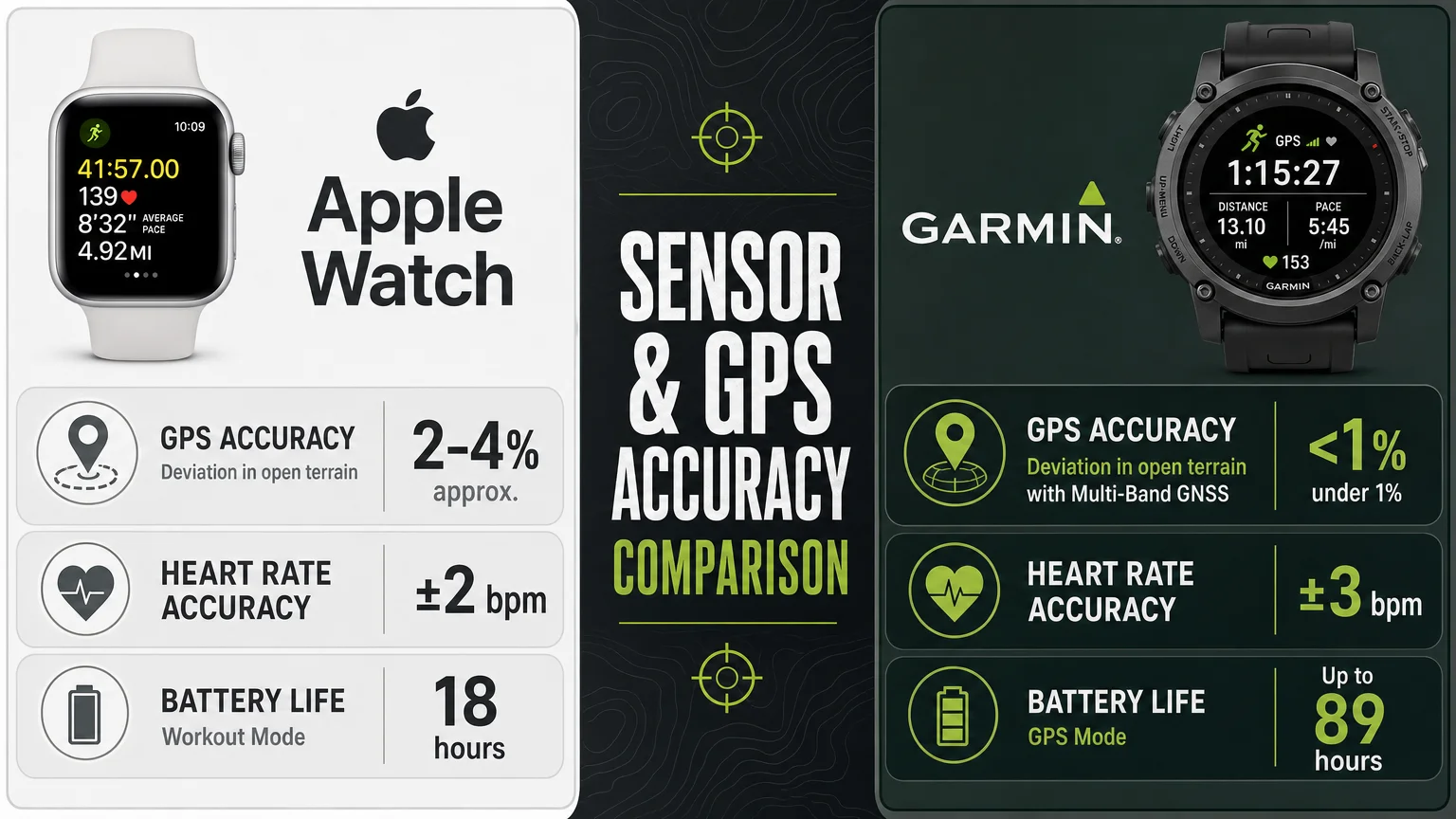
For track workouts and standard road marathons, the practical difference is small enough that neither device will mislead your training. The gap widens on technical mountain trails, where Garmin’s longer satellite lock history and more aggressive signal filtering keep the trace cleaner. If your primary discipline is trail ultrarunning or orienteering, Garmin’s advantage here is real and worth factoring into your decision.
What Does Battery Life Actually Mean for Race Day?
Battery life is where the Apple Watch vs Garmin for serious athletes comparison becomes decisive for a specific subset of athletes. Apple Watch Ultra 2 offers approximately 60 hours in low-power mode and around 18–20 hours in full GPS workout mode. That covers a fast marathon, an Ironman, and most 100-mile ultramarathon finishing times — but not the back-of-the-pack ultra athlete who may be on course for 30-plus hours.
Garmin Fenix 8 Solar (51mm) advertises up to 89 hours in GPS mode and substantially longer in expedition/UltraTrac mode. For multi-day adventure races, ski mountaineering events, or any competition where charging mid-race is not an option, Garmin’s advantage is not marginal — it is categorical. Apple Watch requires a MagSafe charge stop; Garmin does not, for most competitive distances.
For athletes whose longest events run under 12 hours, battery life is a non-issue on either platform.
How Do the Training Analytics Compare?
Garmin’s training ecosystem is more mature and more granular for performance athletes. Features like Training Readiness, HRV Status, Training Effect (aerobic and anaerobic), Acute Load, and sport-specific VO2 Max estimates for running, cycling, and swimming have been refined across multiple hardware generations. The Garmin Connect platform surfaces these metrics in a structured way that coaches and self-coached athletes can act on directly.
Apple Watch’s Fitness app and the broader Apple Health framework are genuinely capable for general health monitoring — resting heart rate trends, sleep stages, cardio fitness (VO2 Max estimate), and Activity rings. Third-party apps like Strava, TrainingPeaks, and Runna extend Apple Watch’s training analytics considerably. But the native experience still lacks the depth of Garmin’s built-in training load management. An athlete following a structured plan with periodization blocks will find Garmin’s native tools more immediately useful without additional subscriptions.
That said, Apple’s platform advantage is real for athletes who want their training data to flow naturally into a broader health picture — medication tracking, menstrual cycle data, sleep quality, and mental wellness metrics all live in one place on iPhone.
Which Device Handles Multi-Sport and Triathlon Better?
Garmin has built multi-sport profiles for over a decade. The Forerunner 965 and Fenix 8 both offer auto-transition detection, dedicated open-water swim metrics, cycling power meter support (ANT+ and Bluetooth), and running dynamics including ground contact time and vertical oscillation. These are features Garmin has iterated on through real triathlete feedback.
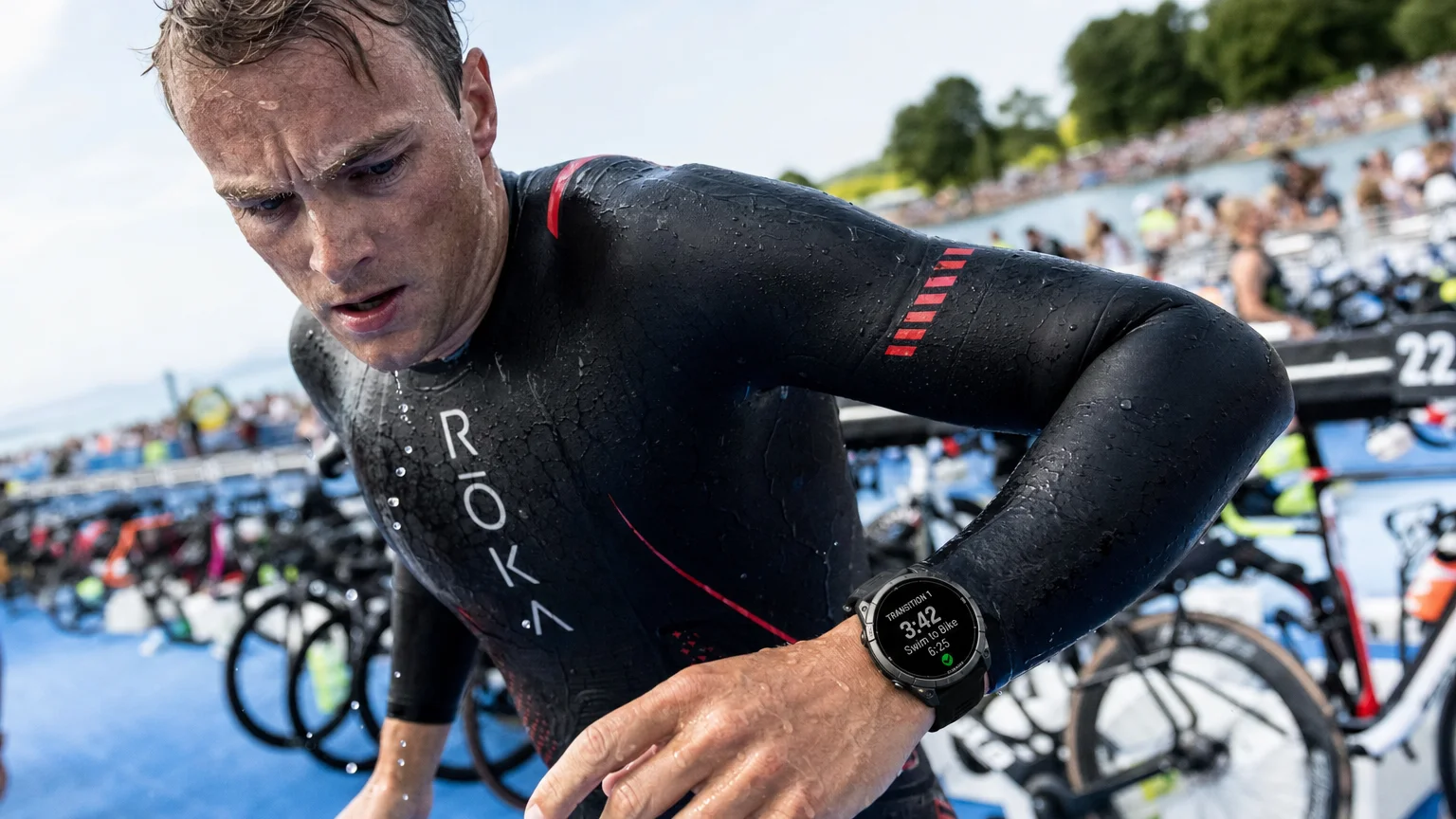
Apple Watch Ultra 2 added a dedicated Triathlon app with manual and automatic transitions, open-water swim tracking, and depth measurement (to 40 meters). For athletes competing in Olympic-distance and Ironman-distance triathlons, the Apple Watch experience is now genuinely functional rather than a workaround. However, it does not yet support ANT+ power meters natively — a meaningful limitation for cyclists who have invested in a power-based training system. Garmin’s ANT+ support is broad and well-established.
For triathletes who want the best-integrated multi-sport tool without relying on third-party apps, Garmin remains the cleaner choice in 2026.
Apple Watch vs Garmin: Side-by-Side Comparison
| Feature | Apple Watch Ultra 2 | Garmin Fenix 8 (51mm) |
|---|---|---|
| GPS Technology | Dual-frequency L1/L5 | Multi-band GNSS (L1/L5/L2C) |
| GPS Battery Life | ~18–20 hrs (full GPS) | ~89 hrs (GPS mode) |
| Heart Rate Sensor | Optical (3rd gen) | Optical + wrist-based HRV |
| ANT+ Support | No | Yes |
| Native Training Load | Basic | Advanced (multi-metric) |
| Multi-Sport Profiles | Yes (Triathlon app) | Yes (extensive) |
| Smartwatch Features | Excellent | Moderate |
| iPhone Integration | Native, seamless | Companion app only |
| Water Resistance | 100m (EN 13319) | 100m |
| Price (approx. 2026) | ~$799 | ~$899–$999 |
Does Heart Rate Accuracy Differ Between the Two?
Both devices use photoplethysmography (PPG) optical sensors on the wrist, and both face the same fundamental limitation: wrist-based optical HR degrades during high-cadence, high-intensity efforts where wrist movement introduces noise. Independent validation studies, including research published in the Journal of Sports Sciences, show that consumer wrist-based HR monitors from both Apple and Garmin perform well during steady-state cardio (within ±3 bpm of chest-strap reference) but can show errors of 10–20 bpm during sprint intervals or heavy strength training.
Neither platform has solved this physics problem. Athletes who need reliable HR data during interval sessions should pair either device with a chest strap — both Apple Watch and Garmin support Bluetooth HR monitors, and Garmin additionally supports ANT+ straps. For HRV-based recovery monitoring, Garmin’s morning HRV Status feature is more integrated into its training recommendations than Apple’s current implementation.
Which Watch Makes More Sense as an Everyday Device?
If the watch stays on your wrist beyond training hours, Apple Watch’s advantage in daily usability is substantial. Notifications, Apple Pay, Siri, third-party app support, and the depth of Apple Intelligence features make Apple Watch a genuinely capable wrist computer. Garmin watches are functional for notifications and basic smartwatch tasks, but the interface is optimized for sport, not for navigating a calendar or replying to messages.
Athletes who train once or twice a day and spend the rest of their time in meetings, at a desk, or managing a business will likely find Apple Watch’s daily experience more aligned with how they actually live. For context on how Apple Watch Ultra 2 compares within Apple’s own lineup, the Apple Watch Ultra 2 vs. Series 10 comparison on this site covers that ground in detail.
The Bottom Line
The Apple Watch vs Garmin for serious athletes question does not have a single correct answer — it depends on what “serious” means for your specific sport and lifestyle. Garmin wins on battery endurance, multi-sport depth, ANT+ connectivity, and training analytics for athletes who want a purpose-built performance tool. Apple Watch Ultra 2 wins on daily usability, iPhone integration, health platform breadth, and the overall smartwatch experience.
A competitive ultramarathoner or Ironman athlete who needs 30-plus hours of GPS tracking should choose Garmin. A runner or cyclist who also wants a capable everyday device and trains within standard event durations will find Apple Watch Ultra 2 more than adequate — and in many respects, more pleasant to wear every day.
For a deeper look at how Apple Watch fits into a broader Apple setup, explore the Accessories & Gear section on this site, or read more about setting up a new iPhone the right way to get the most out of Apple Watch’s iPhone integration from day one.
Frequently Asked Questions
Is Apple Watch accurate enough for marathon training?
Yes. Apple Watch Ultra 2 and Series 10 both produce GPS distance accuracy within 1–2% on open road courses, which is sufficient for marathon training. Pace and distance data will be reliable for the vast majority of training runs.
Can Apple Watch replace a Garmin for a serious triathlete?
For Olympic and Ironman distances, Apple Watch Ultra 2 is a functional triathlon tool. It lacks ANT+ power meter support, which is a limitation for power-based cycling training. Athletes who need deep multi-sport analytics natively may still prefer Garmin.
Does Garmin work well with iPhone?
Garmin pairs with iPhone via the Garmin Connect app and syncs data reliably. However, it does not integrate with Apple Health as deeply as Apple Watch does, and smartwatch features like notifications are more limited than on Apple Watch.
Which has better sleep tracking?
Both platforms track sleep stages. Garmin's Body Battery and HRV Status features provide more actionable recovery guidance tied directly to training recommendations. Apple Watch's sleep data feeds into Apple Health and is useful for trend monitoring but less prescriptive for athletes.
What is the price difference between Apple Watch Ultra 2 and Garmin Fenix 8?
As of 2026, both sit in the $799–$999 range depending on configuration. The Garmin Fenix 8 Solar variants carry a premium. Neither is a budget purchase.
Does Apple Watch support running power?
Apple Watch does not natively display running power, though some third-party apps (like Stryd's companion app) can surface it. Garmin supports running power natively via compatible footpods and its own Running Power feature.
Which watch is better for hiking and navigation?
Garmin has a stronger navigation feature set, including topographic maps, breadcrumb trails, and turn-by-turn routing stored on-device. Apple Watch Ultra 2 added Waypoints and a compass app, but Garmin's mapping tools are more comprehensive for backcountry navigation.
Founder and editor of We Are MacWise, with more than 30 years of Apple-focused IT experience helping professionals and small businesses.
